Many Hong Kong parents consider transferring their children from traditional schools to international schools in order to improve their English. The benefits are twofold: children gain an international outlook, and the move also lays out the groundwork for future overseas higher-education pathways. In this article, we outline the appropriate age to apply for an international school transfer and the typical admission requirements. We also provide practical guidance to help parents prepare thoroughly, so their children can settle in smoothly to a new environment.
When to transfer to an international school: What is the most suitable age to apply?
As of the 2025/26 academic year, Hong Kong has 52 international schools (excluding special schools), offering a total of more than 48,000 places for primary and secondary education.[1] However, places are extremely limited, meaning that competition for admission each year is fierce. In addition, international schools typically impose specific age requirements, so advance planning is essential. That said, some entry year groups may be more likely to secure places than others. If you apply strategically at the right time, your chances of being offered a place may improve.
13-year schooling (Year 1 to Year 13)
International schools following the British curriculum generally provide a 13-year education structure, from Year 1 (primary school Year 1) through to Year 13 (secondary Year 6), which is one year more than the local mainstream system.
Within this model, Year 7 (typically around ages 11–12) is the most common entry point for international schools, with applications usually opening around March to April each year. As a rule of thumb, families should begin preparation at least 12 to 18 months in advance—especially the second half of Primary 5 (i.e., when key application and interview procedures are likely to take place).
In terms of which entry years are generally most suitable, families often focus on:
- Year 1: the entry point for primary school, though places are limited.
- Year 7: the most popular transfer year; many schools expand intake around this stage, and relevant applications are often opened in the latter part of Primary 5 or later.
Parents should also note that the local and international education systems differ. For example, if a student is considering transferring into Year 7, applying only in Primary 6 may mean missing the relevant admission window.
Limitations of other entry years
- Year 8 or Year 9: more suitable for schools that offer an International General Certificate of Secondary Education (IGCSE) programme at these stages. Year 9 is often a key year for option selection and curriculum planning.
- Year 10 and Year 11: admission is often significantly more difficult because the two-year IGCSE programme may have already begun.
- Year 12 and Year 13: schools usually do not accept new entrants due to the structure of A-level or IB Diploma programmes.

Source: Shutterstock
Why Parents Make the Switch: International School Benefits
The strength of international schools lies in providing a multi-cultural, English-immersion environment. Students are encouraged to develop critical thinking and creativity. Beyond academic performance, schools also place emphasis on students’ social development and emotional wellbeing, offering more opportunities to participate in a wide range of co-curricular activities.
Compared with traditional local schools, class sizes in international schools are often smaller, and teacher-to-student ratios are typically higher. Lessons place greater emphasis on interaction and discussion.
Common reasons parents choose international schools include:
- Stronger English instruction quality: concerns about the level of English teaching in local schools can lead families to prefer an international school environment where English is used naturally and consistently.
- Learning approach alignment: a student’s learning style may be a better fit for the international school model, rather than the more traditional local approach, testing style, and homework expectations.
- A clearer pathway to overseas university: many international schools offer programmes such as IB, IGCSE, or A-level, which can support students’ progression towards universities in the UK, the US, Australia, and beyond.
Some people assume that transferring schools means a child struggled academically or was unhappy at their local school. In reality, most transfer students generally perform well academically and socially in their local schools; the transfer is often simply driven by a need to prepare for admissions and long-term study plans.
Can local students apply to international schools?
International schools in Hong Kong are not limited to non-local (expat) students. All international schools consider applications from local students, including those holding a Hong Kong passport. According to Education Bureau statistics, for the 2025/26 academic year, local students account for nearly 34% of the total student population in Hong Kong international schools, while non-local students make up approximately 66%.[1]
Although some schools may prioritise non-local applicants, local students are not automatically excluded. In practice, what matters most is whether the applicant meets each school’s specific admission requirements.
Source: Shutterstock
The challenges of transfer: Can students adjust to a fully English-speaking environment?
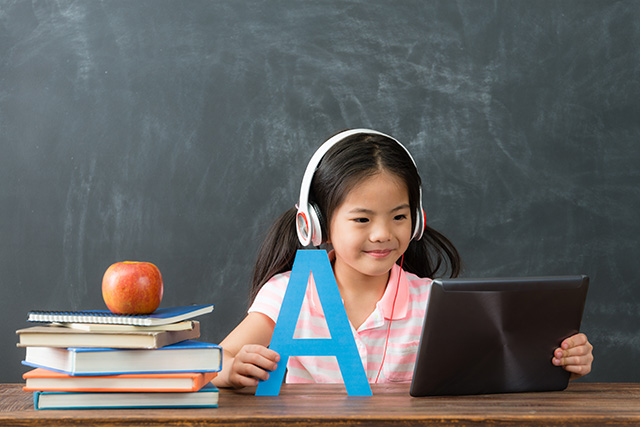
Even when some local schools use English for teaching, communication outside lessons is often still predominantly in Chinese. International schools typically require coursework and assessments to be completed in English (with the exception of Chinese language subjects). In addition, the social environment is almost entirely English-speaking—from everyday conversations with classmates to interactions with teachers in co-curricular settings. This results in higher demands on students’ listening, speaking, and writing abilities.
In general, local students may face the following challenges after transferring:
- Language switching challenge: grammar may be reasonably strong, but creativity and analytical writing may lag behind peers.
- Narrowness of writing styles: students may find it harder to understand and write in different genres (e.g., persuasive writing and creative writing).
- Confidence in spoken English: speaking ability and confidence may initially be weaker than that of classmates in the same year group.
However, these challenges are not unique to local students. Even students whose first language is English may need time to adjust to the more creative and open-ended learning style commonly encouraged in international schools.
International school transfer requirements: How can parents prepare their child?
If parents worry that their child may struggle to adapt to an international school environment, they should begin by carefully reviewing the English requirements of the target schools in advance. Some schools offer additional English support programmes, while others may require students to be fully fluent before admission.
In general, international schools require applicants to pass an internal English assessment prior to transfer, or to submit proof of language ability such as IELTS. Parents may consider arranging tuition or pre-enrolment preparation from around Year 4 or Year 5, so their children build confidence before making the transition.
Adaptation and growth after transferring
Although most students are able to integrate into a new school within approximately 3 to 6 months, the ease of adjustment depends largely on the child’s personality and the timing of the transfer. Once children pass the initial adjustment period, they often begin to experience the benefits more clearly:
- Lessons can feel more engaging and enjoyable.
- Homework loads may be lighter.
- School culture can be more creative, relaxed, and positive.
That said, older children may already be used to learning that follows standard answers. If the new school’s approach places stronger emphasis on initiative, independent thinking, and creativity, they may initially find it challenging to adjust.

Source: Shutterstock
Making the Right Move: Key Takeaways for International School Transfers
In summary, although admission requirements can be demanding, the benefits of international schools are substantial. Students not only gain exposure to different cultures and co-curricular activities—helping to develop creativity and independent thinking—but they also benefit from an excellent environment for improving English.
However, because international schools have specific age requirements for entry, parents should first compare each school’s admission conditions and the level of support offered, and prepare in advance.
If you are considering whether to transfer your child, don't hesitate to get in touch with Grove Education. We will explain in detail the best timing for a transfer, the international school environment, and its key advantages. While adjusting to an English-medium setting can be challenging at first, with sufficient preparation beforehand, children are more likely to settle in quickly—laying a strong foundation for future overseas university applications.
References:
- Education Bureau - International Schools in Hong Kong