With its rich academic heritage, intensive one-year curricula, and world-class institutional reputations, the United Kingdom has long been the premier destination for Hong Kong students pursuing postgraduate education. However, given that tuition fees and living expenses at elite British universities are considerable, meticulous early planning is a critical factor for success. This guide provides a comprehensive breakdown of the latest UK Master’s rankings, entry thresholds, application procedures, and financial budgets to help you strategically plan your academic path.
Why Pursue a Master’s Degree in the United Kingdom?
The British higher education system is internationally acclaimed, with numerous institutions consistently securing top positions in global league tables. Beyond vast academic resources, studying a Master’s in the UK offers several unique advantages:
- An Efficient One-Year Curriculum: British taught Master’s programmes (Taught Master’s) are typically completed within 12 months. This significantly reduces both opportunity costs and living expenses, making it an ideal option for working professionals and students wishing to enter the career market swiftly.
- Accessible Admission Pathways: The vast majority of postgraduate programmes in the UK do not require applicants to submit Graduate Record Examination (GRE) or Graduate Management Admission Test (GMAT) scores, relying instead on undergraduate academic performance and English proficiency [1].
- Post-Study Work Opportunities: Upon successful completion of their degree, international students can apply for a Graduate Visa. This allows graduates to remain in the UK for up to two years to seek employment or establish a business, serving as an excellent stepping stone for a career in Europe [2].
Source: Gemini
UK Master’s Rankings: Elite Institutions for 2026
According to the QS World University Rankings 2026, the UK delivers a formidable performance with 17 universities placing within the global top 100 [3].
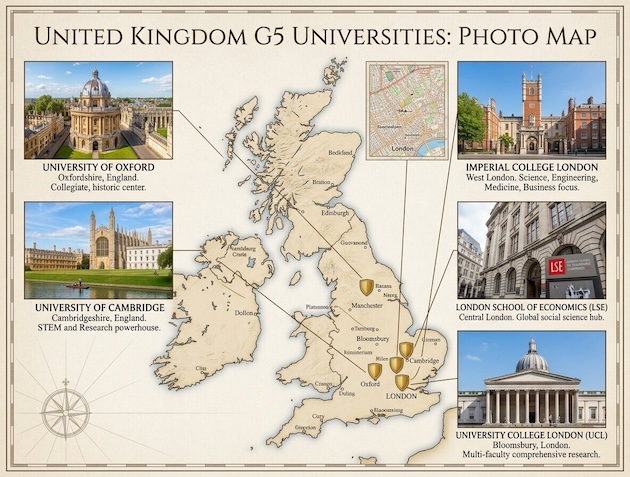
The "G5" Super Elite Universities
The "G5" represents the pinnacle of British academic excellence and remains the most competitive tier for applicants from Hong Kong:
| University | QS World Ranking 2026 |
|---|---|
| Imperial College London | 2nd Globally |
| University of Oxford | 4th Globally |
| University of Cambridge | 6th Globally |
| University College London (UCL) | 9th Globally |
| London School of Economics and Political Science (LSE) | Top 60 Globally |
Prominent Russell Group Institutions
Beyond the G5, several universities within the prestigious Russell Group hold elite positions in the global rankings. These include King's College London (KCL, ranked 31st globally), the University of Edinburgh (34th), the University of Manchester (35th), the University of Warwick, and the University of Bristol. These institutions hold outstanding reputations across disciplines such as Business, Engineering, and the Social Sciences [3].
UK Master’s Requirements: Academic and Language Benchmarks
To secure admission, applicants from Hong Kong must satisfy the following general criteria [4][5]:
- Academic Background: A recognised Bachelor’s degree, typically with an Upper Second-Class Honours (2:1) classification or a minimum GPA of 3.3. Competitive fields such as Business, Engineering, and Computer Science will strictly scrutinise the relevance of undergraduate modules.
- English Language Proficiency: Most programmes require an IELTS Academic overall band of 6.5 (with no sub-score below 6.0). Elite G5 institutions, as well as competitive Law and Media courses, generally mandate a score of 7.0 or above.
- Application Portfolio: A complete academic transcript, graduation certificate (or proof of enrolment), a Personal Statement, academic references, and a CV. Creative Arts and Design applicants must also submit a professional portfolio.
- Specialised Requirements: Certain MBA or high-level Finance programmes may require GMAT scores alongside relevant professional work experience.
Note: For applicants whose undergraduate grades or language scores fall slightly short of direct entry thresholds, a Pre-Master’s programme or a Pre-sessional English course offers an excellent preparatory pathway.

Source: Gemini
Tuition Fees and Estimated Living Expenditure
Postgraduate fees vary by discipline and institution, with total expenses in the London area generally being around 30% higher than in regional cities. Below is an annual budget forecast for international students [6]:
- Tuition Fees: Because most taught Master's programmes span a single year, fees generally range from £9,000 to £30,000 (approx. HK$95,400 – HK$317,700), depending on the subject.
- Living Costs: Due to higher consumer prices in London, monthly living expenses are estimated between £1,300 and £1,400 (approx. HK
$13,600 – HK$ 14,700). In regional areas, this budget ranges from £900 to £1,300 (approx. HK $9,450 – HK$13,650).
Estimated Monthly Expenses Breakdown (Excluding Rent)
| Expense Item | London Region (Per Month) | Regional Areas (Per Month) |
|---|---|---|
| Utilities & Internet | £140 | £80 |
| Groceries & Essentials | £155 | £116 |
| Socialising & Leisure | £150 | £80 |
| Transport | £103 | £54 |
| Mobile Phone (SIM-Only) | £18 | £18 |
The Postgraduate Application Timeline
British universities operate on a rolling basis (applications are processed as they are received), meaning that places become limited later in the admissions cycle. Timely submission is paramount [7]:
- August – September: Finalise your target institutions and courses, prepare for the IELTS examination, and compile supporting documents.
- September – December: Postgraduate application portals open. It is highly recommended to submit initial applications before the Christmas closure in December. For G5 universities and highly competitive Business degrees, we advise submitting by October.
- January – March: Applications are reviewed; some programmes may require formal interviews or the submission of additional files.
- March – May: Upon receiving an offer, confirm your selection, pay the deposit, and request your Confirmation of Acceptance for Studies (CAS).
- June – August: Submit your Tier 4 student visa application, arrange student accommodation, and secure insurance.
- September: Depart for the United Kingdom to commence your postgraduate studies.
Important Advisory: Prospective applicants should note that there are ongoing discussions indicating that the UK Graduate Visa duration may be adjusted to 18 months in future cycles. Enrolling for the 2026/27 academic year remains the optimal window to benefit from the current two-year post-study work privilege [2].

Source: Shutterstock
Launch Your UK Educational Journey with Grove Education
The United Kingdom continues to attract top talent from Hong Kong through its premier academic resources, cultural diversity, and internationally respected qualifications. However, standing out in a highly competitive application landscape demands a strategic approach to school selection and profile building.
If you have questions regarding university choices, entry prerequisites, or financial planning, contact the consultancy team at Grove Education. Our professional advisors will design a bespoke application strategy to help you secure a place at an elite British institution.
References
1. UCAS - Entry requirements for UK courses
2. UK Government - Graduate visa
3. QS Top Universities - QS World University Rankings 2026: Top global universities
4. University of Oxford - International qualifications
5. Unversity of Cambridge - Postgraduate Study
6. British Council - Cost of studying and living in the UK
7. British Council - How to apply - postgraduate