When considering overseas higher education, France—with its deep cultural heritage and global leadership across multiple sectors—has long been a dream destination for many students. However, the entry thresholds for international applicants vary significantly across different institutional frameworks.
This comprehensive guide details French postgraduate tuition fees, application windows, and subject-specific entry prerequisites. Our goal is to help you design the optimal academic strategy based on your unique academic background and long-term career aspirations.
Understanding the French Postgraduate Higher Education Framework
The higher education architecture in France differs substantially from the systems found in Hong Kong and the United Kingdom. Beyond traditional public universities, France operates several independent elite school networks. While each framework carries distinct academic and professional trajectories, international applicants primarily engage with two main systems:
Public Universities (Universités)
French public universities are highly regarded for their academic research output and multidisciplinary pedagogy. They offer a vast portfolio of courses spanning literature, the humanities, fundamental sciences, engineering, medicine, and the social sciences. A premier example is Sorbonne University, which delivers versatile curricula allowing students to build personalized academic pathways tailored to their individual backgrounds and career goals [1].
Elite Professional Schools (Grandes Écoles)
The Grandes Écoles constitute a highly selective, elite tier of education unique to France. Characterised by competitive admissions, these institutions maintain deep ties with global corporations and government bodies. They favour small-class teaching, highly internationalised student cohorts, and immediate career readiness. Notable icons within this network include HEC Paris, École Polytechnique, ESSEC Business School, and Kedge Business School [2][3][4][5].

Source: École Polytechnique
Top 4 Master’s Programme Recommendations in France
France offers an extensive selection of English-taught programmes across high-demand sectors such as business, advanced engineering, and cognitive sciences, meaning that a command of the French language is not a prerequisite for admission.
1. Master in Strategic Management
Business remains the most heavily subscribed sector for international students in France. HEC Paris’s flagship Master in Strategic Management is ranked 1st globally in the QS Business Master’s Rankings 2026 [6]. The curriculum focuses intensively on strategic analysis, problem-solving, and executive leadership development. Students cultivate real-world managerial decision-making capabilities through corporate business projects, live case studies, and advanced management simulations [7].
2. Master of Science and Technology
France holds a formidable international reputation in mathematics, engineering, and scientific research. Driven by global trends, postgraduate tracks in artificial intelligence, data science, and technology have become highly popular. The Master of Science and Technology at École Polytechnique is a premier choice for ambitious international students.
The degree utilizes a rigorous multidisciplinary model featuring 12 specialized tracks, including Artificial Intelligence, the Internet of Things (IoT), Environmental Engineering, and Sustainable Energy Management. Alongside theoretical modules, students work directly with industry partners on live corporate projects, field excursions, and collaborative industrial seminars [8].
3. Master in Cognitive Science
For students targeting specialized academic research in philosophy, psychology, or neuroscience, the French public university system is an exceptional fit. The Master in Cognitive Science at Sorbonne University guides students through the functional mechanisms underlying human perception, memory, and linguistics. Emphasising a deeply collaborative, interdisciplinary research spirit, this track is ideal for candidates intending to progress to doctoral research (PhD) [9].
4. MSc, Master of Science ISLI Global Supply Chain Management
As global enterprises place increasing weight on cross-border logistics, procurement, and supply chain resilience, operations management has emerged as a high-value corporate discipline. The ISLI MSc in Global Supply Chain Management at Kedge Business School focuses on international logistics architectures. The core curriculum covers [10]:
- Logistics Analytics
- Strategic Procurement
- Cross-border Transportation Networks
- Digital Supply Chain Technologies
- Sustainable Supply Chains
A major advantage of this programme is the opportunity to execute real-world consultancy projects for major multinationals—such as Airbus, LVMH, Sonepar, and Lectra—allowing students to solve live supply chain challenges, build professional networks, and acquire immediate industry experience.
Admission Requirements and Entry Prerequisites
Entry criteria, required portfolios, and fee matrices can vary across faculties within the same university. Applicants must verify the latest official specifications on their target course pages. Standard benchmarks for flagship French postgraduate tracks include:
1. HEC Paris: Master in Strategic Management Prerequisites [11]
Candidates must upload a certified digital portfolio containing:
- Certified copy of your undergraduate degree scroll or official proof of current enrollment.
- Complete university academic transcripts (including exchange semesters and cumulative GPA).
- A current professional CV.
- Official standardised test report: GMAT, GRE, or TageMage.
- Proof of English proficiency (TOEFL, TOEIC, IELTS, or Cambridge).
- Two formal online letters of recommendation (at least one from an academic professor).
- Passport-style photograph and identification documents.
- Non-refundable application fee: €170.
Note: While standardised test scores and language results are mandatory components, HEC Paris does not enforce an arbitrary minimum cutoff score. Applicants whose native language is English, or who completed their undergraduate degree entirely at an English-medium university, are eligible for a language waiver.
2. École Polytechnique: MSc and Technology Prerequisites [12][13]
- Master 1 (Year 1 Entry): Applicants must hold a minimum three-year international Bachelor’s degree (equivalent to 180 ECTS credits) with a strong quantitative background in science or engineering.
- Master 2 (Direct Year 2 Entry): Applicants must already hold a relevant Master’s degree or have successfully completed a Master 1 phase.
Portfolio Checklist:
- Complete university transcripts.
- Personal CV.
- Statement of Purpose / Motivation Letter.
- Valid passport or national identity card.
- Contact details for two formal academic or professional referees.
- Non-refundable application fee: €90 [14].
Candidates who pass the initial document screening must undergo a formal technical interview conducted via video link.
English Language Proficiency Thresholds:
Because the curriculum is delivered entirely in English, non-native speakers must present valid proof of proficiency:
- TOEFL iBT: Minimum score of 95.
- IELTS Academic: Overall band of 7.0.
- Cambridge C1 Advanced (CAE): Grade C or above.
- Waivers are granted if your prior degree was delivered entirely in English.
3. Sorbonne University: Master in Cognitive Science Prerequisites [15]
As a research-driven track, candidates must present an academic background directly aligned with the cognitive sciences, typically holding a degree in:
- Psychology, Biology, or Philosophy
- Linguistics, Mathematics, or Physics
- Computer Science or an equivalent technical engineering/medical Master 1 qualification.
Portfolio Checklist:
- Valid passport or certified European residency documents.
- Cover Letter / Statement of Purpose (in English).
- Detailed personal CV (in English, maximum 2 pages).
- An academic Writing Sample (in French or English).
- Complete post-secondary academic transcripts and degree certificates.
- Proof of English language proficiency matching CEFR C1 level benchmarks.
- At least one formal Letter of Recommendation submitted directly by the referee.
Candidates can further support their language proficiency by presenting proof of prior studies in an English-speaking country, research internships executed in English, or published academic papers.
Kedge Business School: MSc Global Supply Chain Management Prerequisites [16]
Kedge operates two distinct entry pathways based on prior academic credits:
Short Track Prerequisites (Direct MSc Entry):
- Completion of a Master 1 phase; OR a four-year international Bachelor’s degree comprising at least 240 ECTS credits.
Long Track Prerequisites (Extended 2-Year Track):
- A standard three-year university Bachelor’s degree comprising 180 ECTS credits. Long Track candidates must complete a one-year foundational pathway course prior to entering the formal one-year MSc phase.
Portfolio Checklist:
- Current CV and valid passport/ID copy.
- Certified copy of your highest academic diploma achieved and complete official transcripts.
- Proof of current student enrollment (if applicable).
- Valid proof of English language proficiency.
- Non-refundable application fee: €120.
- Letters of recommendation and certified employer reference letters are optional but highly recommended.
English Proficiency Requirements Matrix:
Because the Short Track stream skips the foundational year and enters direct MSc modules, it carries a higher language threshold:
| Standardised Language Test | Short Track | Long Track |
|---|---|---|
| TOEIC | 785 | 720 |
| TOEFL iBT | 79 | 70 |
| IELTS | 6.0 | 5.5 |
| Cambridge | First 160(B2)、Advanced 180(B2) | Preliminary 153 |
| Duolingo | 105 | 100 |
If you are an English native speaker, or you have worked in an English-speaking country for more than one year, or you have studied a full-time course taught in English for at least one year, you are generally exempt from submitting evidence of English language proficiency.

Source: HEC Paris
Tuition Fees Comparison: Public Universities vs Grandes Écoles
According to Campus France, the national agency for the promotion of French higher education, the state heavily subsidises public universities, resulting in very low tuition fees [19]. Conversely, the corporate-tied Grandes Écoles operate on independent capital models with higher fee structures.
A comparative breakdown of total annual tuition fees across the four flagship tracks is outlined below:
| Institution | Programme Track | Official Tuition Fees (2026/27 Academic Year) |
|---|---|---|
| HEC Paris | Master in Strategic Management | €43,350 Total (Tuition: €38,400; International Surcharge: €2,000; Services: €1,950; Admin: €1,000) [17] |
| Ecole Polytechnique | MSc & Technology | Standard tracks are €15,400. Flagship joint programmes are higher: AI for Markets is €19,000; Data Science & AI for Business (X-HEC) is €28,950 [14]. |
| Sorbonne University | Master in Cognitive Science | Standard registration fee is €254. Non-EU international students frequently receive partial fee exemptions, bringing total estimated costs to €3,941 per annum [18][19]. |
| KEDGE Business School | MSc Global Supply Chain Management | Short Track: €20,400 total; Long Track: €30,100 total (comprising a €9,700 pathway year and €20,400 MSc tuition) [16]. |
Postgraduate Application Timelines and Deadlines
Application schedules vary across institutional tiers. Business schools and Grandes Écoles typically operate a series of independent application rounds or rolling review systems. In contrast, public universities generally manage a single centralized window from winter to early spring.
The official application deadlines for the respective tracks are structured as follows:
HEC Paris: Master in Strategic Management (5 Sequential Rounds) [11]
- Round 1: 1 October 2025
- Round 2: 12 December 2025
- Round 3: 19 February 2026
- Round 4: 9 April 2026
- Round 5: 28 May 2026
École Polytechnique: MSc and Technology (4 Sequential Rounds) [20]
- Round 1: 13 October 2025
- Round 2: 12 January 2026
- Round 3: 9 March 2026
- Round 4: 22 April 2026
Sorbonne University: Master in Cognitive Science (Fixed Single Window) [15]
- Portal Open: 1 December 2025
- Portal Close: 1 March 2026
Kedge Business School: MSc Global Supply Chain Management (Rolling Evaluation Rounds) [16]
Applications are reviewed as they are received. The portal closes early once all cohort seats are allocated. Early submission is highly recommended.
- Round 1: 26 April 2026
- Round 2: 10 May 2026
- Round 3: 31 May 2026
- Round 4: 7 June 2026
- Round 5: 21 June 2026
Admissions Notice: The dates above reflect the official timelines for the 2026/2027 academic intake. As certain institutions have not yet finalized schedules for the 2027/2028 cycle, prospective applicants should monitor upcoming university releases for subsequent adjustments.
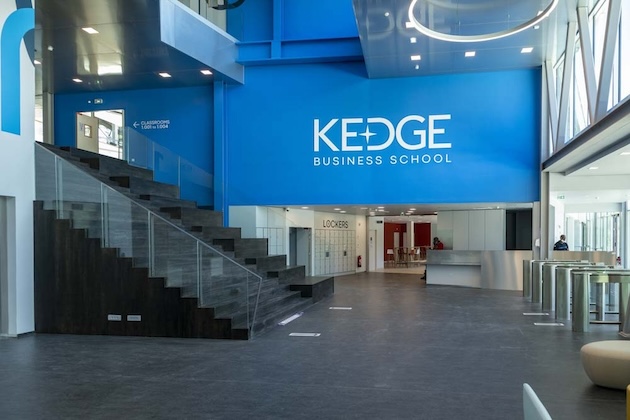
Source: Kedge Business School
Launch Your European Corporate Career with Grove Education
Whether you aim to enter multinational corporate boardrooms, join cutting-edge tech sectors, or pursue advanced doctoral research, a Master’s degree from France offers an exceptional global asset for students from Hong Kong. However, managing fragmented information, coordinating across multiple institutional application portals, and tracking specific ECTS credit-mapping requirements can be complex.
If you require professional advice on profile building, document refinement, or financial mapping, contact the consultancy team at Grove Education. Backed by years of experience in managing applications for elite European institutions and Grandes Écoles, our professional consultants provide comprehensive guidance tailored to your academic background and career goals, ensuring your study abroad journey to France is a complete success.
References
1. Sorbonne University – Study at Sorbonne University
2. HEC Paris – Master’s Programs
3. École Polytechnique – À propos des programmes
4. ESSEC Business School – ESSEC Business School
5. KEDGE Business School – Student Portal
6. QS Top Universities – QS Business Master’s Rankings 2026: Management
7. HEC Paris – Master in Strategic Management – Course Content
8. École Polytechnique – Master of Science & Technology
9. Sorbonne University – Master in Cognitive Science
10. KEDGE Business School – ISLI Global Supply Chain Management
11. HEC Paris – Master in Strategic Management – Admissions
12. École Polytechnique – Language & Academic Requirements
13. École Polytechnique – Admissions to École Polytechnique
14. École Polytechnique – Tuition Fees
15. Cog-SUP – Application
16. KEDGE Business School – ISLI Global Supply Chain Management – Admission & Funding
17. HEC Paris – Master in Strategic Management – Fees and Financing
18. Sorbonne University – Preparing Your Stay
19. Campus France – Tuition Fees in France
20. École Polytechnique – Application Deadlines & Procedure