The Swiss Maturité diploma is the primary entrance qualification for Swiss universities and Federal Institutes of Technology. Examination regulations may vary depending on the applicant's circumstances and the specifics of each canton. Therefore, it is crucial to clearly understand the examination system and salient points. This article will guide you through the main aspects of the two systems: the Federal examination and the state high school system, aiding you in comprehensively mastering your educational planning.
Introduction to the Swiss Maturité Diploma
Before discussing the Swiss Maturité examinations, students should first understand the types of diplomas available in Switzerland and their classifications. As an essential examination for further education in Switzerland, the Maturité examination is comparable to other countries' "university entrance exams" or "A-levels." This diploma is the primary pathway for Swiss students to apply to universities or Federal Institutes of Technology. According to the Swiss education system, there are mainly two forms of the Swiss Maturité diploma (both academically equivalent) [1], allowing students to apply to Swiss public universities, Federal Institutes of Technology, and Teacher Training Universities [2] (Universities of Applied Sciences have additional requirements [3]; for medical-related disciplines, candidates must also take the Medical Studies Aptitude Test (EMS)) [4]. Below are descriptions of the two types of diplomas:
Federal Diploma (Eidgenössische Maturität / Maturité fédérale)
The Federal Diploma examination provides an avenue for external candidates to obtain equivalent academic qualifications. Candidates need not attend a public high school and can prepare for the examination through self-study or by enrolling in a private school, subsequently receiving the diploma upon passing the examination. [5] To register for the Swiss Federal Maturité examination, candidates must be at least 18 years old. For candidates opting to take the examinations in parts, those taking the first part (1P) must be at least 17 during the first examination and reach 18 before the second part (2P) [6]. Candidates are also required to pay the examination fees.
State High School Diploma (Gymnasiale Maturität / Maturité Gymnasiale)
The State High School Diploma is the main pathway for Swiss students to enter university, primarily for those studying in public high schools (Gymnasiums) or state-approved private schools in various cantons. After completing their high school curriculum (generally four years, although some cantons offer a six-year programme, such as in Zurich [7]), students must participate in examinations held by their schools or respective cantonal authorities [2].
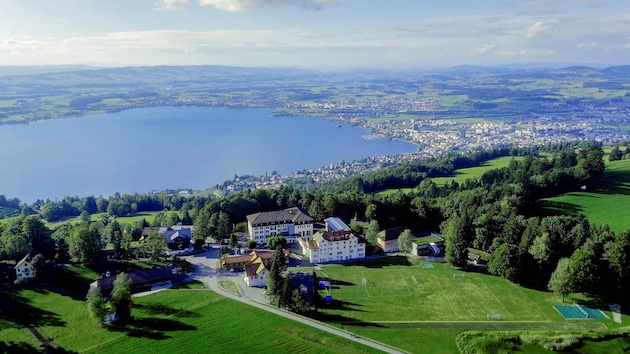
Source: Institut Montana
Overview of Subjects for the Federal Diploma
The structure of subjects for the Federal Diploma is as follows: [5]
- 10 core subjects (fundamental subjects)
- 1 professional elective subject
- 1 supplementary elective subject
- Maturité thesis
Core Subjects for the Federal Diploma
The core subjects of the Swiss Federal Maturité are mandatory for all students, aiming to establish the essential knowledge required for university admission. There are a total of ten subjects, including:
- First language (German/French/Italian)
- Second national language (German/French/Italian)
- Third language (German/French/Italian/English/Greek/Latin)
- Mathematics
- Biology
- Chemistry
- Physics
- History
- Geography
- Visual Arts or Music.
Additionally, Philosophy may be taken as an extra core subject.
Professional and Supplementary Elective Subjects
To broaden students' academic scope and depth, the Swiss Maturité examination includes two categories of elective subjects: professional electives and supplementary electives, which enhance students' academic understanding and interdisciplinary capabilities, as detailed below: [5][8]
Professional Elective Subjects (Option spécifique, choose one)
- Classical Languages (Latin/Greek)
- Modern Languages (the third national language, English, Spanish, or Russian, depending on the canton)
- Physics and Applied Mathematics
- Biology and Chemistry
- Economics and Law
- Philosophy/Education/Psychology
- Visual Arts
- Music
Supplementary Elective Subjects (Option complémentaire, choose one)
- Physics
- Chemistry
- Biology
- Applied Mathematics
- History
- Geography
- Philosophy
- Economics and Law
- Psychology/Education
- Visual Arts
- Music
- Sports
- Computer Science
Restrictions on Elective Subjects
It is important to note that the Swiss Federal Maturité examination imposes restrictions on the choice of professional and supplementary elective subjects:
Language Restriction: The same language cannot be selected as both a "core subject" and a "professional elective."
Elective Restrictions: The same subject cannot be chosen as both a "professional elective" and a "supplementary elective"; if the professional elective is a combined subject, the supplementary elective cannot include any of its constituent subjects.
- For example, if the professional elective is "Physics and Applied Mathematics," the supplementary elective cannot be "Physics" or "Applied Mathematics."
- Similarly, if the professional elective is "Biology and Chemistry," the supplementary elective cannot be "Biology" or "Chemistry," and
- if it is "Philosophy/Education/Psychology," the supplementary elective cannot be "Philosophy" or "Psychology/Education."
Arts and Physical Education Restrictions: If "Visual Arts" or "Music" is selected as a professional elective, the supplementary elective cannot include either of these subjects or Physical Education. Furthermore, if a core subject has already been selected as Visual Arts or Music, the supplementary elective cannot repeat these.
Maturité Thesis for the Federal Diploma
The Swiss Federal Maturité examination explicitly requires the Maturité thesis to be completed independently. The thesis must involve data collection, analysis, and application based on a chosen research topic, with a word count between 3,800 and 4,200 words, accompanied by a 15-minute oral presentation or discussion [8].
Calculation and Passing Scores for Federal Examinations
The Federal Diploma utilises a points system, with different weighting applied to various subjects, as detailed in the following weighting table: [5]
| Subject | Weighting |
|---|---|
| First Language (German/French/Italian) and Professional Electives | 3x |
| High Ability Subjects (second or third national languages or Mathematics)* | Advanced subjects weighted at 3x, general subjects at 2x |
| Biology, Chemistry, Physics, History, Geography, Visual Arts or Music, Supplementary Electives | 1x |
| Maturité Thesis | 1x |
* High Ability Subjects: In the Swiss Federal Maturité examination, there are requirements for high ability subjects (advanced subjects weighted at 3x and general subjects at 2x), where candidates must select one subject from the following three at advanced level:
- Second national language (German/French/Italian)
- Third language (English/Spanish/Russian/another national language/Latin/Greek)
- Mathematics
If Mathematics is chosen as the advanced subject (weighted at 3x), language subjects will have a weighting of 2x. Candidates may arrange subjects according to relevant regulations and committee recommendations; details are available in the Federal Examinations Guidelines.
Passing Score Standards
The weighted passing score for the Swiss Federal Maturité examination must meet the following criteria: [8][9]
- Total score of 105 (or higher)
- If the total score is between 84 and 104.5, no more than four subjects can be below a score of 4, and the total score difference for those subjects must not exceed 7 points (i.e., the sum of scores below 4 must be no greater than 7).
- If the score for the Maturité thesis is below 4, a new thesis must be rewritten and submitted.
Examination Regulations for the Federal Exam
The Swiss Federal Maturité examination conducts direct examinations that do not incorporate continuous assessment grades. Due to the number of subjects, candidates can choose to complete all subjects in one sitting or take them in two parts. Candidates who opt for division must first complete Part One (1P) and then sit Part Two (2P) [10]; the interval between the two examinations must not exceed one year [9]. Below is an introduction to the partitioned examinations: [8]
Part One Examination (1P)
The subjects for the first part of the examination (written) include:
- Biology
- Chemistry
- Physics
- History
- Geography
Visual Arts or Music will be examined in a specific format.
Part Two Examination (2P)
The second part of the examination will cover:
- Core Subjects: Mathematics (written + oral)
- Electives: Professional Electives (written + oral), Supplementary Electives (oral)
- Maturité Thesis: examined in a specific format
Resit Opportunities
The Federal Diploma examination allows for a maximum of two resits. Subjects achieving below a score of 4 must be fully retaken; if the Maturité thesis score is below 4, it also must be rewritten and re-presented [8].

Source: Ecole Privée Chantemerle
Structure of the State High School Diploma Examination in Switzerland
The diploma examination for Swiss state high schools is delineated as follows: [1]
- Common Areas (Core Subjects)
- Mandatory Areas (1 Professional Elective + 1 Supplementary Elective) and the Maturité Thesis
- Physical Education (may be exempted for adult learners)
The curriculum and teaching content are established according to each canton’s educational regulations, and not all schools may offer every subject. The curriculum is typically four years long and must adhere to the following distribution of instruction hours:
- Languages (Language of Instruction, Second Language, Third Language): No less than 27%
- Mathematics and Natural Sciences: No less than 27%
- Humanities and Social Sciences: No less than 12%
- Visual Arts or Music: No less than 6%
- Professional Electives + Supplementary Electives + Maturité Thesis: Total must be at least 15%
Additionally, the adult education framework is designed for adults wishing to obtain a state high school diploma, requiring attendance at a state-accredited evening school for three years, after which completion of the specified curriculum and examinations will grant a diploma [2].
Content of the Maturité Examination for State High School Diplomas
The grading composition for the state high school diploma includes the following: [1]
- Subjects with final examinations (requiring five subjects): calculated based on the average of the last year's continual assessment and graduation exam, each contributing 50%.
- Subjects without graduation exams: utilise the semester grades from the last instructional year (100%).
- Maturité Thesis: an independent assessment encompassing both written work and oral presentation components.
Subjects for the State High School Diploma Maturité Examination
Core Examination Subjects
The core subjects for the state high school diploma largely mirror those of the Federal Diploma, though minor variations may occur in different cantons:
- National language used for instruction
- Second national language (German/French/Italian)
- Third language (German/French/Italian/English/Greek/Latin)
- Mathematics
- Information Technology
- Biology
- Chemistry
- Physics
- History
- Economics and Law
- Visual Arts, Music (the latter may be studied together)
In the cantons of Bern, Fribourg, and Valais, the second national language must be the other official language of that canton. In Graubünden, Romansh or Italian may be listed alongside German as the language of instruction.
Professional and Supplementary Electives
Students must choose one subject as a professional elective and one as a supplementary elective. Options can be selected from core subjects, or additional subjects may be chosen based on the regulations of different cantons. However, the following restrictions must be adhered to:
- The same language cannot simultaneously be both a core subject and a professional elective.
- The same subject cannot serve as both a professional elective and a supplementary elective (details on other conditions will be established within the schools' regulations).
State Diploma Maturité Thesis
The thesis is intended to cultivate students’ independent research and critical thinking abilities. It must involve academic research and may be completed individually or collaboratively, followed by an oral presentation.
Final Examination Score Standards for the Swiss State High School Diploma Maturité
n addition to classroom performance, the Swiss state high school diploma requires a final graduation examination to assess whether students meet subject requirements. This examination typically encompasses five subjects: [1]
- First Language (Language of Instruction)
- Second National Language
- Mathematics
- Professional Elective
- Another subject (determined by each canton)
It should be noted that all five subjects must undergo written examinations, with language subjects potentially incorporating oral examinations as supplementary assessments.
Passing Conditions for the Swiss State High School Diploma
The Swiss Maturité examination is distinguished by national principles and cantonal regulations. The national level establishes unified standards, while each canton may adjust specific implementation methods (such as the ratio of written to oral examinations or score conversion formulas). Each candidate is afforded two opportunities to pass the examination to obtain the diploma.
National Standards
The Swiss state high school diploma primarily evaluates students on their overall academic performance and final academic capabilities. All subjects, including core subjects, elective subjects, and the graduation thesis, are assessed on a scale of 1 to 6, with 6 being the highest and 4 the passing mark. The following conditions must be met:
| Condition | Item | Specific Requirement | Notes |
|---|---|---|---|
| A | Compensation Mechanism | The total of all "additional scores" above 4 must equal or exceed double the "deficient scores" total below 4. | It means that the scores for "strengths" must be more than double those of "weaknesses" to compensate for them. |
| B | Number of Failures | The total number of subjects with final scores below 4 must be ≤ 4. | No more than four subjects (including the thesis) may fall below the passing grade, or the candidate will be deemed not competent. |
Examples of Cantonal Standards
The following are examples of three cantons with slight differences from the national standards:
Canton of Geneva (Genève): Averages are first obtained from written and oral examinations, then averaged with the grades from the last year; both contribute 50% (calculations extend to one decimal place, then rounded) [11].
Canton of Vaud (Vaud): There are three scoring methods [12]:
- Language subjects: Maturité oral examination score = 2/3 from spoken test and 1/3 from listening test.
- Subjects with both written and oral components: The final grade = 50% from last year’s academic year grade, 25% from Maturité written examination, and 25% from Maturité oral examination.
- For subjects with only a written or only an oral component: The final grade is 50% from the last year’s results and 50% from Maturité examination results.
Canton of Ticino (Ticino): Diploma score = average of annual results and examination results, with a threshold of 0.25/0.75, rounded to 0.5 or whole number [13].

Source: Sutterstock
Contact GROVE Education for the Swiss Maturité Examination
The Swiss high school diploma is not only a gateway to Switzerland’s top institutions but is also internationally recognised. By understanding the various regulations and score details related to the Swiss Maturité examination, you can better navigate your educational direction. If you are planning to apply to Swiss universities using the Maturité examination as part of your application, we welcome you to consult with Grove Education, where professional advisors can assist you in taking the first successful step towards studying abroad.
References:
3. Swiss Conference of Cantonal Ministers of Education (EDK) – Universities of Applied Sciences
4. Swissuniversities - Admission to Medical Studies with Numerus Clausus in Switzerland
7. Canton Zürich - Gymnasium und Maturitätsschule
11. République et Canton de Genève - Directives Maturité Juin 2024 – Élèves
12. Canton de Vaud - Directive relative à l’examen de maturité (DA_DREM)