In our years of admissions consultancy and student support, we have observed that many applicants spend extensive time collecting “winning formulas”, memorising stock phrases, and even using the same interview techniques and self-presentation templates to apply to Cambridge. Yet, despite otherwise strong results, these applicants sometimes fail to receive offers. This is because the University of Cambridge places far greater emphasis on applicants’ subject interests, critical thinking ability, and potential for academic development. In this article, we set out the key strategies for preparing Cambridge interviews and admissions tests, providing practical guidance for students who are considering applying.
Key points for writing a Cambridge personal statement
The Cambridge personal statement is made up of the UCAS personal statement (within the stated word limit) together with Cambridge’s supplementary personal statement for the specific course.[1]
UCAS personal statement structure (up to 4,000 words)
The UCAS personal statement (with a maximum of 4,000 words) is generally structured into three parts, designed to demonstrate your academic interests and potential.[1]
1. Talk about your academic interests
Explain why you are interested in the subject, focusing on your motivations and abilities related to the discipline—for example, what skills you have developed, and why you believe the course is a strong fit. Avoid simply stating: “I have always wanted to study this subject.”
2. Tell us how you've explored your subject
Describe how you have actively explored the subject beyond the classroom. This might include additional reading, documentaries and talks, podcasts, or online study. However, do not just list activities. Instead, explain how these experiences genuinely deepened your interest and helped you prepare for studying the subject at the university level.
3. Tell us what you've learned
Focus on your thinking and what you gained. Highlight any interesting concepts you encountered through further reading, how you questioned or challenged ideas, what you learned, and how connections emerged between different areas of interest. The aim is to show that you already have the ability and genuine academic curiosity to go deeper when studying at Cambridge.
Cambridge supplementary personal statement (up to 1,200 words)
Cambridge’s supplementary personal statement is limited to 1,200 words. It is intended to add any relevant background, learning interests, or ways you have explored your subject that were not fully covered in the UCAS personal statement.[2] For example, you may select a specific pathway within your chosen course and explain why you want to study it, making clear what specifically draws you to Cambridge and this course in particular.[2]

Source: Shutterstock
3 Cambridge supplementary personal statement (up to 1,200 words)
Over the past years, we have seen many applicants’ statements fail to resonate because they unintentionally make one (or more) of the following three mistakes:
1. Turning the personal statement into a list of achievements
Many students draft their statement by recording every award, position, and certificate, hoping that “more” will lead to stronger results. In practice, this approach often produces content that reads like an achievements log, making it difficult to demonstrate your motivation for the subject and your academic depth. From Cambridge’s admissions perspective, they want to see whether you are genuinely committed to the course you are applying for, whether you can develop further in that field, and whether your interest is likely to be sustained over time.
- When we guide students to write their Cambridge supplementary statement, we typically do two things:
- Categorise your activities to distinguish what is directly relevant to your application subject from what is simply an interest or a responsibility.
- Select the key experiences that have driven you to deepen your understanding and devote sufficient space to analysing them—so that, within limited word counts, there is a clear and compelling link between you and the subject.
2. Not showing the thinking behind your learning
Many students describe their learning experiences by listing a long set of books or online course titles. This adds limited value for admissions teams when assessing your academic potential. A stronger approach is to take one or two learning experiences and demonstrate the depth of thinking you engaged in, including:
- Identify a particular argument or theory that stood out—perhaps even something you had reservations about.
- Explain why you found it confusing, uncertain, or in tension with what you previously believed.
- Describe how you actively sought additional evidence to support or challenge the idea, such as reading papers, data, or historical case studies.
- Share what concrete changes occurred in your understanding of the subject as a result.
These traces of your thinking help admissions tutors see your actual reasoning process—not just what you consumed or completed. They show whether you have the academic approach required to succeed at Cambridge.
3. Failing to keep the content tightly focused on the target subject
We do not recommend writing “for appearance” by adding activities that are only loosely connected to your course in order to look well-rounded. Instead, what matters is whether you have a coherent academic thread: a sustained direction for long-term development that keeps close alignment with the course, and that the admissions team can clearly recognise.
If your genuine interests involve things such as:
- spending long periods conducting scientific experiments or solving mathematical problems,
- reading economic history, international relations history, or primary philosophical texts independently,
- writing literary criticism, developing programming projects, or producing research reports,
then these “apparently narrow” engagements can be your most persuasive strengths—as long as they align with your application subject. We help you organise these experiences into a clear, layered academic development narrative rather than scattered snapshots, so admissions tutors can see your capacity and willingness to develop deeply in a specific area.
Why admissions tests are becoming increasingly important: Cambridge test preparation tips
More and more applicants now arrive with near-perfect grades (for example, A-levels at AAA* or IB 40+). As a result, academic results alone are often no longer enough to distinguish who is best suited to Cambridge. Admissions tests therefore play an important additional role as an assessment indicator.
Cambridge admissions tests may include:
- standardised tests arranged in advance (e.g., ESAT, for relevant subjects),
- subject-specific written tests designed by faculties, which may take place before or after interviews,
- small assessments combining reading, reasoning, calculation, or writing tasks.
Source: Shutterstock
How Grove Education can help you prepare for Cambridge—master exclusive practical techniques
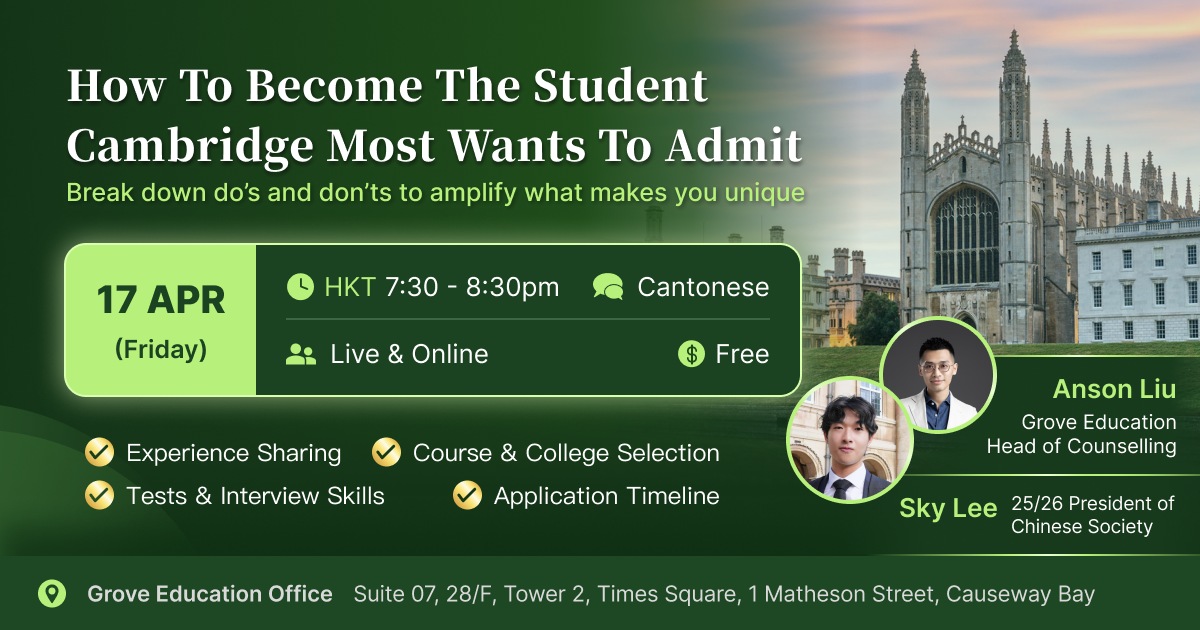
Are you finding your admissions tests preparation is turning into rote memorisation? Worried that nerves during interview will prevent you from showing your real ability? Grove Education will be hosting a specialist admissions talk on 17 April: “Don’t Be a Template Applicant: How to Become the Student Cambridge Most Wants to Admit”. Grove Education’s Admissions Director, Anson Liu, together with Sky Lee, President of the Cambridge University Chinese Society, will explain exclusive, hands-on preparation strategies for Cambridge admissions tests and interviews—helping you build a genuinely competitive advantage. Places are limited, so you can register using the link as soon as possible.
Cambridge interview overview and key tips
Cambridge interviews usually last between around 35 minutes and 1 hour. They can be held in person or online. Most applicants attend between one and two interviews, while some may need to attend three to four interviews, depending on the faculty’s arrangements.[3]
Interviews typically involve:
- 2 to 3 interviewers asking questions relevant to your chosen subject.
- You being asked to explain diagrams, text materials, mathematical or scientific problems on the spot, including how you reach your solutions and the reasoning behind your approach.
- For subjects such as Medicine and Veterinary Medicine, discussion may extend to issues related to professional responsibility or ethics.
- Exploring why you have chosen to study the course at Cambridge, and your views on key questions or recent developments in the discipline.
- Follow-up questions on any recent learning or activities you mentioned in your application or personal statement.
- Broad academic questioning to assess your wider academic interests, future plans, and how well you match the course.
What matters most in the assessment
Some students rely on memorising past questions. However, Cambridge has made it clear that interviewers want to understand how you think and how you respond to new information. Questions therefore evolve by year and by subject, specifically to observe how candidates handle unfamiliar scenarios—not whether they can recall old answers. If a question is slightly changed, memorisation alone does not adapt well, and it can become difficult to respond naturally in discussion.
Interviews as a form of small academic discussion
Many successful applicants describe the Cambridge interview as similar to a small tutorial session: conversation structured around a small number of academic questions (often 2–3). After you answer one question, interviewers typically follow up, challenge your viewpoint, and observe how you adjust your thinking in real time. Questions generally progress from easier to more demanding, and some may extend beyond what is covered in textbooks—again, to assess how you handle new situations rather than checking whether you are “correct” on everything.
Interview success tip: build depth using the historical context of the discipline
Many students who gain offers mention that understanding the historical context of their subject helped them answer interview questions with greater depth and clarity. Beyond your core reading, you should therefore consider adding:
- the sequence in which key theories and concepts emerged, and the historical and academic context at the time,
- differences between schools of thought, major debates, and processes by which ideas were challenged or replaced,
- how major historical events pushed the discipline in new directions (e.g., economic crises, technological breakthroughs, social movements).
Examples include:
- Economics: how events such as stagflation or financial crises challenged existing theories and contributed to shifts in policy and mainstream approaches.
- Physics: how the limitations of classical mechanics, in light of new experimental results, helped lead to the development of quantum theory.
- Literature: the interaction between literary movements, the social/political climate of their time, and broader intellectual ideas.
Important interview preparation considerations
The following are official Cambridge guidelines for preparing for interviews:[4]
- Revisit the works: In the weeks and days leading up to the interview, re-read your personal statement and any written work you submitted, and think in advance about the key points you might be asked to discuss.
- Academic discussion in English: Discuss your most interesting topics in English with teachers, classmates, or family members, and ideally arrange mock interviews with teachers so you can practise explaining ideas and problem-solving clearly and coherently.
- Practise critical thinking: For arts applicants, read beyond the syllabus (primary texts and commentary) and write down and analyse your own views. For science applicants, do more practice questions and practise explaining your approach step-by-step.
- Adjust your mindset: Being invited to interview already indicates you have academic potential. You do not need to “get everything right”; the goal is to demonstrate your reasoning process and learning potential.
- Technical preparation: For online interviews, test your equipment and environment. For in-person interviews, allow enough time to familiarise yourself with the campus.
Source: Shutterstock
Want to learn how to become “the Cambridge applicant they want”? Register for the talk now
Do you worry that you might be seen as a “template applicant” who cannot stand out? Grove Education is hosting a high-value admissions talk: “Don’t Be a Template Applicant: How to Become the Student Cambridge Most Wants to Admit”, led by Admissions Director Anson Liu and Sky Lee, President of the Cambridge University Chinese Society. They will share practical strategies for Cambridge admissions tests and interviews, break down the approach behind successful offers, and show you what it takes to become “the applicant Cambridge really wants”. Opportunities like this are limited—register now to secure your place.
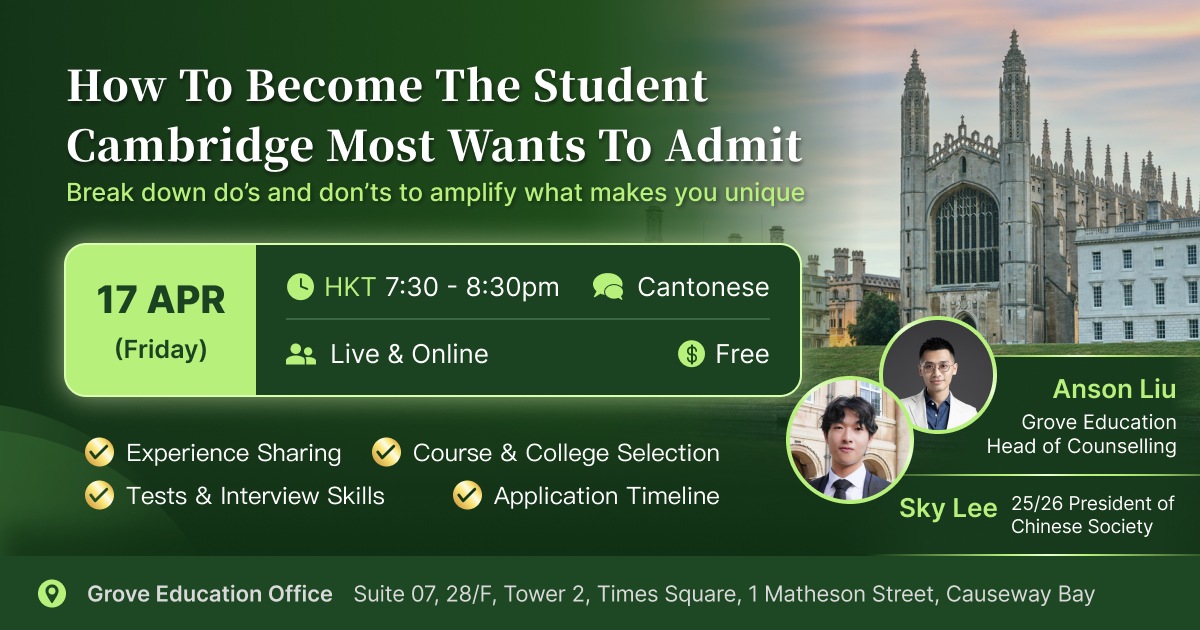
《 Don’t Be a Template Applicant: How to Become the Student Cambridge Most Wants to Admit 》seminar highlight:
- Understanding What Cambridge Really Looks For
- Course and College Selection Strategies
- Building Your Competitive Edge
- Exclusive Insights into Admissions Tests and Interviews
- The Golden Application Timeline and Common Pitfalls
For event details, please refer to: 《 Don’t Be a Template Applicant: How to Become the Student Cambridge Most Wants to Admit 》
References:
1. University of Cambridge - Writing your personal statement | Undergraduate Study
2. University of Cambridge - Completing My Cambridge Application | Undergraduate Study
3. University of Cambridge - What to expect at your Cambridge interview | Undergraduate Study
4. University of Cambridge - Preparing for your Cambridge interview | Undergraduate Study