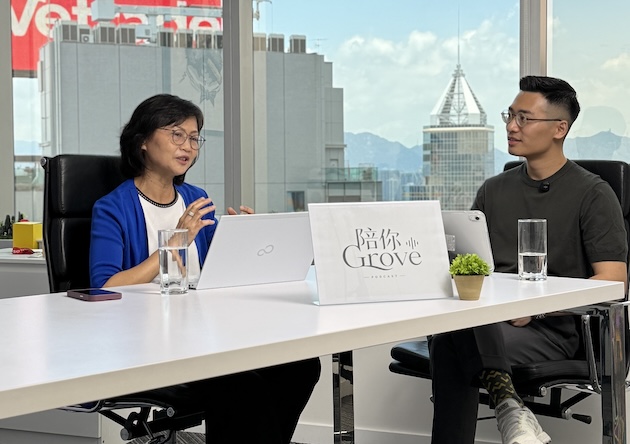
In recent years, parents in Hong Kong have faced an unprecedented level of information anxiety when planning their children's educational pathways. With the world-shifting changes brought about by AI, both parents and students are facing massive impacts. In the first episode of our podcast《陪你Grove:大學招生官的真心話》, we specially invited Annie Kung, a former University Admissions Assistant Director with 30 years of experience in the education sector and the current Principal Higher Education Specialist at Grove Education, for an in-depth conversation with Grove Education's Head of Counselling, Anson Liu. This article distils the core insights for parents planning their children's futures, breaking down the common myths surrounding the DSE and international curricula.

DSE or International Curricula? Early Planning and the Logic of Choice
One of the most frequently asked questions by parents is whether their children should study the DSE or an international curriculum. Most parents roughly decide on the educational system during their child's primary school years, primarily based on future expectations such as emigration, studying abroad, or understanding local culture. However, by junior high school (Forms 2 and 3), a child's learning abilities and personality traits become much clearer, and they are more capable of expressing their own opinions, prompting many families to reassess their educational direction.
- The Earlier, the Better: Discussions regarding university pathways should happen as early as possible to allow ample time for preparation and arrangements.
- Prioritise the Student's Traits: When choosing between the DSE, IB, or A-Level, the primary considerations should be the student's preferences, academic abilities, personality traits, interests, and future career planning.
- Interest-Led Subject Choices: If a student is solely interested in astronomy—a subject not offered by universities in Hong Kong—parents might need to arrange for overseas studies, making the GCE A-Level or IB programmes more suitable choices.
Debunking Non-JUPAS Admission Myths: Do Top Students Struggle Too?
There is a common rumour that the "Non-JUPAS route always has an advantage over JUPAS", and some parents even believe that taking the DSE offers a better chance of getting into medical school due to a larger "margin of error" (e.g., scoring 36 out of a maximum 42 across 6 subjects in the DSE leaves room for mistakes, whereas needing a 42 out of 45 in the IB offers less leeway).
Former admissions officer Annie points out the reality of university admissions:
- No Direct Comparisons: Universities do not directly compare different international qualifications, such as the IB and the DSE, as it is akin to comparing apples and oranges and lacks a proper foundation.
- Transparent Data and Meritocracy: Universities are highly familiar with different international qualifications; they carefully study public exam data and grade distributions to admit the best candidates.
- Holistic Assessment: Admission decisions are never based solely on academic grades as a single indicator. Universities comprehensively assess a candidate's overall performance, including non-academic achievements and interview performance.
- No Shortcuts: With information being highly transparent nowadays, trying to take a shortcut by switching to a seemingly "easier" curriculum is unrealistic. If a curriculum is noticeably easier, universities will assess the student's true capabilities even more carefully.
Characteristics of International Programmes and University Preferences
From the university's perspective, institutions do not show favouritism towards any specific curriculum during the admissions process. Candidates who meet the minimum requirements will be considered, but the final decision depends on their overall performance, including school grades, teachers' comments, and extracurricular involvement. Students from different backgrounds bring unique strengths:
- IB: Places a heavier emphasis on expression, leadership, and independent thinking.
- A-Level: Ideal for students with clear academic interests and intentions to study abroad, offering high flexibility when selecting specialised subjects.
- HKDSE: Demands a higher level of bilingual proficiency.
- Canadian & Australian Curricula: Are often related to the background or plans of the parents.
University Survival Rules and Future Subject Trends
Getting into university is only the first hurdle; selecting the right programme and surviving university life presents its own set of challenges.
Easy to Enter, Hard to Graduate: Students must pay attention to the academic demands of a subject. For instance, Engineering generally requires highly advanced mathematical and scientific abilities. Even if the entry threshold seems approachable, many students find the coursework extremely demanding once admitted.
The Invisible Pressure at Top Universities:
- The Hong Kong University of Science and Technology (HKUST): The academic atmosphere is intensely competitive, with a heavy focus on the "mean score", requiring students to have strong stress management skills.
- The Chinese University of Hong Kong (CUHK): Boasts a relatively relaxed atmosphere, which inherently requires students to maintain a high degree of self-discipline.
- The University of Hong Kong (HKU): Known for the fierce competition and unique culture typical of a traditional elite institution.
Furthermore, to tackle complex contemporary issues like global warming, geopolitics, and outer space exploration, interdisciplinary programmes (such as Engineering + Business or Maths + Information Engineering) are rapidly gaining popularity. Universities are actively seeking students who have the capacity to understand and create connections across these disciplinary boundaries. Additionally, while most university programmes do not strictly mandate an exchange, choosing courses with exchange requirements increases a student's chances of successfully participating in overseas study opportunities.
.jpg)
Conquer Non-JUPAS with Grove Education: Secure an Absolute Advantage from an Admissions Officer's Perspective!
Are you currently studying the IB, A-Levels, or other international curricula, but feeling lost about the admission standards of local universities? Worried that academic grades alone won't be enough to stand out in the fierce Non-JUPAS competition?
Grove Education is hosting a dedicated higher education seminar on Saturday, 18 July 2026: “15 Years of Insights from Former Admissions Assistant Director — No More Guesswork on Non-JUPAS"
For this special event, we have invited Annie KUNG, the former Assistant Director of Admissions and Financial Aid at the Chinese University of Hong Kong (who possesses 15 years of experience coordinating JUPAS and Non-JUPAS admissions). Together with Anson Liu, Grove Education's Head of Counselling, they will break down the hidden admission criteria of local Hong Kong universities and the mechanisms for cross-curriculum comparisons from the most authoritative "admissions officer's perspective". Furthermore, the two experts will deeply deconstruct the strategies for writing a compelling Personal Statement, teaching you how to build an unparalleled competitive edge!
Seats for the live event are strictly limited. Click here to register now, and take the guesswork out of your university admissions journey!
Why Choose Grove Education?
In today's complex and ever-changing educational landscape, traditional one-way counselling is no longer sufficient. Grove Education adopts a pioneering, multidimensional approach by combining AI data, objective career-orientation analysis, and psychological assessments to provide comprehensive, personalised counselling for students. This innovative arrangement targets the student's current personal qualities and traits, offering tailored advice for long-term planning to help families avoid unnecessary detours.
There is no "best" curriculum, only the most suitable planning. If you still have questions regarding your child's curriculum choices or future educational pathways, we encourage you to book a professional one-to-one consultation with Grove Education early on, so we can tailor the best admissions strategy for you using technology and expertise