When planning an overseas university education for their children, Hong Kong parents are looking beyond university rankings and academic reputation. Tuition fees, living costs, course content and career opportunities after graduation are becoming equally important considerations. The UK has long been a popular destination for Hong Kong students interested in business-related subjects, while Dutch universities offering degrees taught entirely in English are increasingly worth exploring.
If two universities are just two places apart in the world rankings, how much could the cost of a three-year degree differ?
According to the QS World University Rankings 2027, the University of Amsterdam (UvA) is ranked 60th in the world, while the London School of Economics and Political Science (LSE) is ranked 62nd. Although their overall rankings are close, the institutions differ in their academic strengths, course structures and costs of studying abroad.
For Hong Kong students planning to begin university overseas in 2027, should the Netherlands be on the shortlist alongside the UK? This guide compares LSE's BSc Econometrics and Mathematical Economics with UvA's BSc Business Analytics. We examine their rankings, estimated three-year costs, curricula, internship opportunities, graduate prospects and entry requirements to help families choose a route that reflects a student's interests, academic strengths and longer-term ambitions.

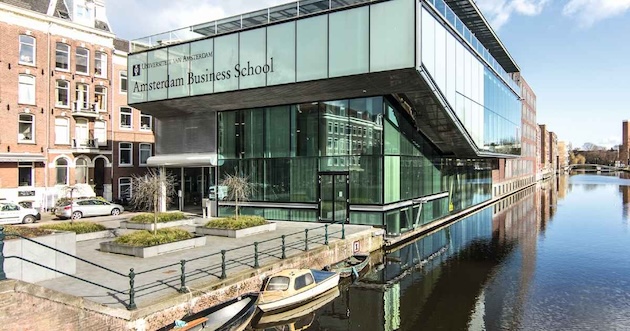
Source: University of Amsterdam
Why consider the Netherlands for a business-related degree? LSE vs UvA rankings
LSE and UvA are separated by only two places in the QS World University Rankings 2027, but they offer distinctly different academic approaches to economics, business analytics and data science.
LSE is particularly well known for economics and social science research. Its BSc Econometrics and Mathematical Economics focuses on mathematical economics, econometrics and research methods, making it attractive to students with a strong interest in quantitative analysis and economic modelling.
UvA's BSc Business Analytics combines mathematics, programming, artificial intelligence (AI), machine learning and business management. Its focus is on using data and technology to tackle real-world business problems.
Table 1 | QS rankings and academic focus
| Comparison | LSE (UK) | UvA (Netherlands) |
|---|---|---|
| QS World University Rankings 2027 | 62nd | 60th |
| Degree programme | BSc Econometrics and Mathematical Economics | BSc Business Analytics |
| Standard duration | 3 years | 3 years |
| Language of instruction | English | English |
| Main academic strengths | Economics, mathematics, statistics, econometrics and economic research | Data analytics, AI, machine learning, programming and business decision-making |
| Approach to learning | Theoretical analysis, quantitative models and research methods | Practical technology applications, data-driven decisions and real-world business challenges |
Source: QS World University Rankings 2027.
University rankings can be a useful starting point, but the content of the degree matters just as much. LSE places greater emphasis on economic theory and quantitative research, whereas UvA focuses on applying data analytics and AI in business settings. Parents should consider their child's mathematical ability, academic interests and future career goals when deciding which approach is the better fit.
LSE vs UvA tuition fees for 2027/28: How much does a three-year degree cost?
For Hong Kong families, the overall cost of overseas study is often a major factor in choosing a university. Alongside tuition fees, a realistic budget should account for accommodation, food, transport, insurance and other everyday expenses.
According to the 2027/28 tuition fees cited for the two universities, the annual international tuition fee for LSE's BSc Econometrics and Mathematical Economics is £41,900. The annual fee for non-European Economic Area (non-EEA) students on UvA's BSc Business Analytics is approximately €15,730.
Both degrees normally take three years to complete, yet their overall estimated costs differ considerably.
Table 2 | Estimated total cost of studying at LSE vs UvA for three years
| Cost | LSE BSc Econometrics and Mathematical Economics | UvA BSc Business Analytics |
|---|---|---|
| Tuition fee for 2027/28 | £41,900 (approx. HK$440,000) | €15,730 (approx. HK$138,000) |
| Estimated tuition fees over 3 years | £125,700 (approx. HK$1.32 million) | €47,190 (approx. HK$415,000) |
| Monthly living costs, including accommodation (market estimates) | £1,800–£2,760+ (approx. HK$18,900–28,980+) | €1,450–€1,950 (approx. HK$12,760–17,160) |
| Accommodation and living costs over 3 years (36 months) | £64,800–£99,360+ (approx. HK$680,000–1.043 million+) | €52,200–€70,200 (approx. HK$459,000–618,000) |
| Estimated basic total for 3 years | £190,500–£225,060+ (approx. HK$2.00–2.36 million+) | €99,390–€117,390 (approx. HK$870,000–1.03 million) |
Illustrative exchange rates: £1 ≈ HK$10.5; €1 ≈ HK$8.8.
Budget notes: Living costs are market-based estimates that include accommodation. The three-year model assumes 36 months of living costs and holds the 2027/28 annual tuition fee constant for the following two years, although future fees may change. Flights, visas, insurance and other one-off expenses are not included.
Based on these estimates, the basic cost of a three-year undergraduate degree at UvA is approximately HK$870,000–1.03 million, compared with HK$2.00–2.36 million or more at LSE. For families seeking an internationally recognised university education in a data-related subject while managing their budget, UvA is an option worth investigating in more detail.
Budgeting tip: Plan accommodation and living costs early
Accommodation and everyday expenses form a substantial part of the study-abroad budget. Parents can research university housing, private rentals and shared accommodation in London and Amsterdam ahead of time, then build a budget around their child's needs and lifestyle.
Housing can be competitive in both cities, so starting the search early can make the transition easier. It is also sensible to set aside funds for flights, visas, insurance and emergencies, and to allow for changes in exchange rates and living costs.
LSE vs UvA courses: What will students study over three years?
Both LSE's BSc Econometrics and Mathematical Economics and UvA's BSc Business Analytics place considerable emphasis on mathematics, statistics and quantitative analysis. Their academic focus and practical applications, however, are different.
At LSE, students study microeconomics, macroeconomics and econometrics, developing the ability to analyse economic questions using mathematical and statistical methods. The programme also includes advanced economics options and a quantitative thesis, making it well suited to students interested in economic research and mathematical models.
UvA's Business Analytics degree brings together mathematics, programming and business analysis. Students encounter subjects such as Python, data science, machine learning, algorithms and marketing analytics, learning how data can inform decisions within organisations.
Table 3 | Three-year course structure at LSE and UvA
| Stage | LSE BSc Econometrics and Mathematical Economics | UvA BSc Business Analytics |
|---|---|---|
| Year 1 | Microeconomics and macroeconomics, calculus, linear algebra, statistics and introductory econometrics | Calculus, linear algebra, probability and statistics, programming, introductory AI and data analytics |
| Year 2 | Advanced microeconomics, macroeconomics and econometrics, alongside specified optional courses | Machine learning, optimisation, algorithms, data structures and applications of business analytics |
| Year 3 | Advanced economics options, applied econometrics and a quantitative research thesis | In the first semester, students may choose an internship, exchange, minor or optional courses; the second semester includes advanced analytics subjects and a bachelor's thesis |
| Main learning outcomes | Economic modelling, quantitative research and academic analysis | Programming, AI, data analysis and data-driven business decision-making |
Note: This summary is based on the universities' current published programme information. Actual modules and study arrangements for 2027/28 are subject to the universities' latest announcements.
Students who enjoy mathematical reasoning, economic theory and research methods may find LSE's approach especially appealing. Those who want to explore different business applications, develop technical skills and build practical learning into their degree may wish to look more closely at UvA's programme.
Placement year vs internship: How do work experience opportunities differ?
Many parents hope that university will give their children more than academic knowledge. Internships, international exchanges and other forms of practical learning can help students explore career paths and prepare for employment.
A placement year generally refers to an extended period of work experience offered by certain universities, often lasting an academic year. An internship may take place during the summer or a designated part of the course. An exchange normally involves studying academic modules at a partner university abroad.
Table 4 | Internships and international exchange opportunities
| Comparison | LSE BSc Econometrics and Mathematical Economics | UvA BSc Business Analytics |
|---|---|---|
| Standard course duration | 3 years | 3 years |
| Placement year | No standard placement year | No standard placement year |
| Internship opportunities | Students may independently apply for summer internships | An internship is listed as an option in the first semester of Year 3 |
| Internship arrangements | Primarily student-led applications, with support available through LSE Careers | Subject to programme requirements and available opportunities, allowing students to apply their learning in a business setting |
| International exchange | Students can explore and apply for eligible overseas exchange opportunities | Students can choose an exchange at a partner university in the first semester of Year 3 |
| Other flexible options | Economics and selected interdisciplinary optional courses | A minor or optional courses in Year 3 |
| Impact on course duration | Depends on the specific internship or exchange arrangements | Eligible Year 3 options can form part of the standard study plan |
UvA's BSc Business Analytics offers a relatively flexible third year. Students can select an internship, exchange, minor or optional courses according to their interests, before completing their bachelor's thesis.
LSE, meanwhile, provides career development support through LSE Careers, including CV workshops, careers talks, recruitment events and interview preparation. Students can also seek internships independently in finance, consultancy, research and data analytics.
In short, UvA integrates internships and overseas exchanges into the formal set of Year 3 options. At LSE, students generally take a more self-directed approach to internship applications and career exploration. The right choice will depend on a student's goals, eligibility and course arrangements.
Source: University of Amsterdam
LSE vs UvA graduate prospects: Finance, consultancy and employment outcomes
Both degrees develop mathematical, statistical and analytical skills that may be relevant to careers in finance, consultancy, data analytics, technology and economic research.
LSE's emphasis on econometrics and mathematical economic analysis can support routes into finance, consulting, economic research and professional services. UvA's combination of AI, machine learning, programming and business analytics equips students with skills for data-informed decision-making across industries.
UvA provides examples of alumni roles such as Big Data Analyst at KLM, Data Scientist at ING and Consultant Insight and Data at Capgemini. These examples illustrate the variety of sectors in which business analytics skills can be applied.
Table 5 | Graduate career paths and salary reference figures
| Indicator | LSE BSc Econometrics and Mathematical Economics | UvA BSc Business Analytics |
|---|---|---|
| Potential career sectors | Finance, economic research, consultancy and professional services | Data analytics, finance, consultancy and technology |
| Example career directions | Financial analysis, economic research, consultancy and data analysis | Junior data analyst, business analyst, AI specialist and consultant |
| Main professional strengths | Economic modelling, econometric analysis and quantitative research | AI, machine learning and data-driven business decisions |
| Median gross annual salary (reference figure) | Approx. £43,000 a year | Approx. €44,100 a year |
Note: The salary figures refer to median gross annual earnings among surveyed graduates in full-time employment, rather than take-home pay.
Comparing longer-term career development
Both LSE and UvA can help students build knowledge and skills relevant to careers in finance, consultancy and data analytics. Their academic priorities remain different: LSE concentrates on econometrics, mathematical modelling and economic analysis, while UvA places more emphasis on data technologies, AI and their application to business decisions.
Alongside potential graduate roles and salary figures, students should consider their interests, internship opportunities and longer-term career plans when selecting a course.
3-year bachelor's degree vs 4-year bachelor's plus master's: Could studying in the Netherlands cost less?
Families may also wish to consider the combined cost of a bachelor's degree and a master's degree, rather than comparing undergraduate tuition fees alone.
Both the LSE and UvA degrees discussed here are three-year bachelor's programmes. After graduating, students may enter employment or pursue further study.
UvA also identifies its MSc Data Science and Business Analytics as one possible progression route for BSc Business Analytics graduates who wish to deepen their expertise in AI, data science and business analytics.
Table 6 | 3 years at LSE vs 4 years at UvA, including a master's
| Study route | Estimated duration | Estimated basic total cost |
|---|---|---|
| LSE BSc Econometrics and Mathematical Economics | 3 years | Approx. HK$2.00–2.36 million+ |
| UvA BSc Business Analytics | 3 years | Approx. HK$870,000–1.03 million |
| UvA BSc Business Analytics + a related one-year master's degree | 4 years | Approx. HK$1.24–1.45 million |
The 4-year budget is illustrative only. It combines the estimated three-year UvA bachelor's cost with an assumed master's tuition fee of approximately €24,500 for one year, plus 12 months of living costs at €1,450–€1,950 per month. Actual master's fees and future-year costs will depend on the programme chosen and may change.
Under this illustrative model, the basic combined cost of a four-year bachelor's-plus-master's route at UvA remains lower than the estimated basic cost of a three-year bachelor's degree at LSE.
However, a master's degree is a personal educational choice, not a requirement for every Business Analytics graduate. Students should decide whether to continue their studies based on their academic abilities, career ambitions and family budget.
Considering several possible study routes early on can help families assess the financial commitments and longer-term opportunities involved in an overseas education.
Entry requirements for 2027: Applying with HKDSE, IB or A-levels
Students may apply to universities in the UK and the Netherlands using qualifications such as the HKDSE, International Baccalaureate (IB) or A-levels. The two institutions, however, have different academic, mathematical and application requirements.
Students hoping to apply to UvA's BSc Business Analytics with the HKDSE should pay particular attention to the qualification requirements. According to UvA's published guidance for Hong Kong qualifications, applicants need the HKDSE plus successful completion of one year of full-time bachelor's-level university study, including all compulsory first-year credits. They must also have completed an acceptable university-level mathematics course and achieved at least 70% in the OMPT-D mathematics test.
Table 7 | LSE vs UvA: 2027 entry requirements
| Requirement | LSE BSc Econometrics and Mathematical Economics | UvA BSc Business Analytics |
|---|---|---|
| A-levels | A*AA, including A* in Mathematics; check the Further Mathematics subject-combination requirements | At least three recognised A-level subjects at grade C or above, plus at least three separate (I)GCSE subjects at grade C/4 or above that are different from the A-level subjects |
| A-level mathematics | A* in Mathematics is required; A* in Further Mathematics with A in Mathematics is also an acceptable combination | One of the following: (1) grade C or above in Pure Mathematics; (2) grade B or above in Mathematics/Further Mathematics; or (3) grade C or above in Mathematics/Further Mathematics plus at least 70% in OMPT-D |
| IB Diploma | 39 points, with Higher Level grades of 7, 6 and 6, including the specified mathematics requirements | A complete IB Diploma or IB Bilingual Diploma; at least grade 4 in Mathematics: Analysis and Approaches at Higher Level |
| HKDSE | Assessed against LSE's Hong Kong qualification equivalencies and relevant subject requirements | HKDSE plus successful completion of one year of full-time bachelor's-level study (all compulsory first-year credits); an approved university-level mathematics course and at least 70% in OMPT-D |
| English language | Official English language requirements and exemption rules apply | Official English language requirements and exemption rules apply |
| How to apply | UCAS | Studielink + UvA online application |
| Additional requirements | TMUA; very few students are admitted directly into the first year of this programme | Must satisfy the specified academic qualification and mathematics requirements |
| 2027 application deadline | 13 January | 1 April (for students who require a visa or wish to apply for university housing) |
LSE's BSc Econometrics and Mathematical Economics demands a high level of mathematical and economic analytical ability, and applicants must also consider the TMUA admissions test. As very few students are admitted directly into the first year of this programme, prospective applicants should investigate the available entry routes and requirements well in advance.
UvA's BSc Business Analytics places particular emphasis on mathematics and recognised entry qualifications. HKDSE applicants need to consider the additional year of university-level study, while IB and A-level students should check the subject-specific criteria that apply to their qualifications.
For those targeting entry in 2027, subject combinations, English language evidence, qualification equivalencies and deadlines all deserve early attention. Families should allow sufficient time to prepare academic documents, admissions tests and applications.
Should students choose the UK or the Netherlands for a data-related degree? Who might prefer UvA?
LSE and UvA each offer advantages in academic focus, course design, costs and international opportunities. Rather than choosing a university on its ranking alone, students should think about what they enjoy studying, how they prefer to learn, their family's budget and where they hope their career will lead.
UvA's BSc Business Analytics may be especially suitable for three types of students:
- Students interested in AI, programming and data analytics. UvA combines mathematics, coding, AI and business analysis, offering a route for students who want to use data and technology to solve real business problems. Those who enjoy mathematics, computer science, Python or machine learning may welcome this interdisciplinary approach.
- Students who are budget-conscious but want to keep postgraduate study open. UvA's lower estimated undergraduate costs may give families greater flexibility to fund a future master's degree, an international exchange or other learning experiences. The bachelor's-plus-master's route may be worth considering for those balancing educational costs with longer-term qualifications.
- Students looking for internships, overseas exchanges and international experience. In the third year, UvA offers options such as an internship, exchange, minor and elective modules. Students can use these choices to explore their interests and career aims. Amsterdam's finance, technology and international business sectors also offer exposure to a wider European business environment.
Who might be better suited to LSE's BSc Econometrics and Mathematical Economics?
LSE's programme may appeal more strongly to students with a deep interest in economics, mathematics, statistics, econometrics and economic research. Its emphasis on theory, quantitative models and research methods is particularly relevant to those considering economic analysis, financial research or further academic study. Applicants should, however, take special note of the very limited direct first-year intake described for the programme.
The key distinction is that LSE focuses on economic theory and econometric research, while UvA focuses on AI, data technologies and their application to business analytics. Families should make their decision in light of the student's mathematical strengths, academic interests and actual eligibility.

Source: Shutterstock
UK vs Netherlands business analytics degrees: Frequently asked questions
1. Can students take UvA's BSc Business Analytics without speaking Dutch?
Yes. UvA's BSc Business Analytics is taught entirely in English, so students do not need to speak Dutch to complete the degree. The programme brings together students from different countries and provides an international learning environment. Those considering a career in the Netherlands after graduation may nevertheless benefit from learning Dutch during their studies, both for day-to-day communication and for broadening their employment options.
2. Does UvA offer internship opportunities in the third year?
Yes. According to UvA's published programme structure, students can choose an internship, exchange, minor or elective courses in the first semester of Year 3.
Students should explore the relevant requirements and opportunities in relation to their interests and career aims. An internship can form part of their undergraduate study plan where the university's conditions are met and a suitable opportunity is secured.
3. Can international graduates stay and work in the UK or the Netherlands?
Both countries have post-study residence routes for eligible international graduates.
Under the current UK policy, eligible graduates applying for a Graduate visa on or after 1 January 2027 would generally receive 18 months' permission following a bachelor's or master's degree, allowing them to seek work or gain professional experience in the UK.
The Netherlands offers an Orientation Year (Zoekjaar) residence permit, under which eligible graduates can apply to stay for one year to look for work or take up employment.
Immigration eligibility and policy can change. Students should check the latest official guidance from the relevant UK and Dutch immigration authorities before applying.
Grove Education: Planning a university pathway around your child's future
LSE and UvA offer different strengths in academic content, degree structure and the cost of studying abroad. LSE emphasises economics, mathematical models and econometric research, while UvA combines AI, programming and business analytics, with options for internships and international exchanges.
Both the UK and the Netherlands are worth exploring as overseas study destinations. Rankings matter, but choosing the right degree also means considering a student's interests, academic abilities, family budget and future ambitions.
At Grove Education, we provide overseas education advice and university selection support, with a strong focus on career planning. We help students identify their interests and strengths, understand the career pathways linked to different subjects, and align their long-term goals with their university choices.
If you are planning UK or Netherlands university entry for 2027, or would like to understand the HKDSE, IB and A-level requirements and future possibilities associated with Business Analytics or Econometrics, contact Grove Education to discuss your child's options.
University planning should be about more than securing a place. It should help each student find an educational pathway that reflects their interests and long-term career direction.
References
- QS World University Rankings 2027
- LSE — BSc Econometrics and Mathematical Economics
- UvA — Official Tuition Fees
- UvA — BSc Business Analytics Study Programme
- UvA — BSc Business Analytics Programme Brochure
- UvA — BSc Business Analytics After Graduation
- UvA — Entry Requirements for International Qualifications
- UvA — BSc Business Analytics Entry Requirements
- UvA — BSc Business Analytics Application Procedure
- UvA — Business Analytics Mathematics Requirements (OMPT-D)
- UK Government — Graduate Visa
- UK Government — Immigration Rules: Graduate
- Netherlands IND — Residence Permit for Orientation Year